Bún Bò Huế: The Spicy Beef Noodle Soup of Central Vietnam
A lemongrass-and-chilli beef-and-pork noodle soup from the old imperial capital. Bolder, redder and more aromatic than phở.
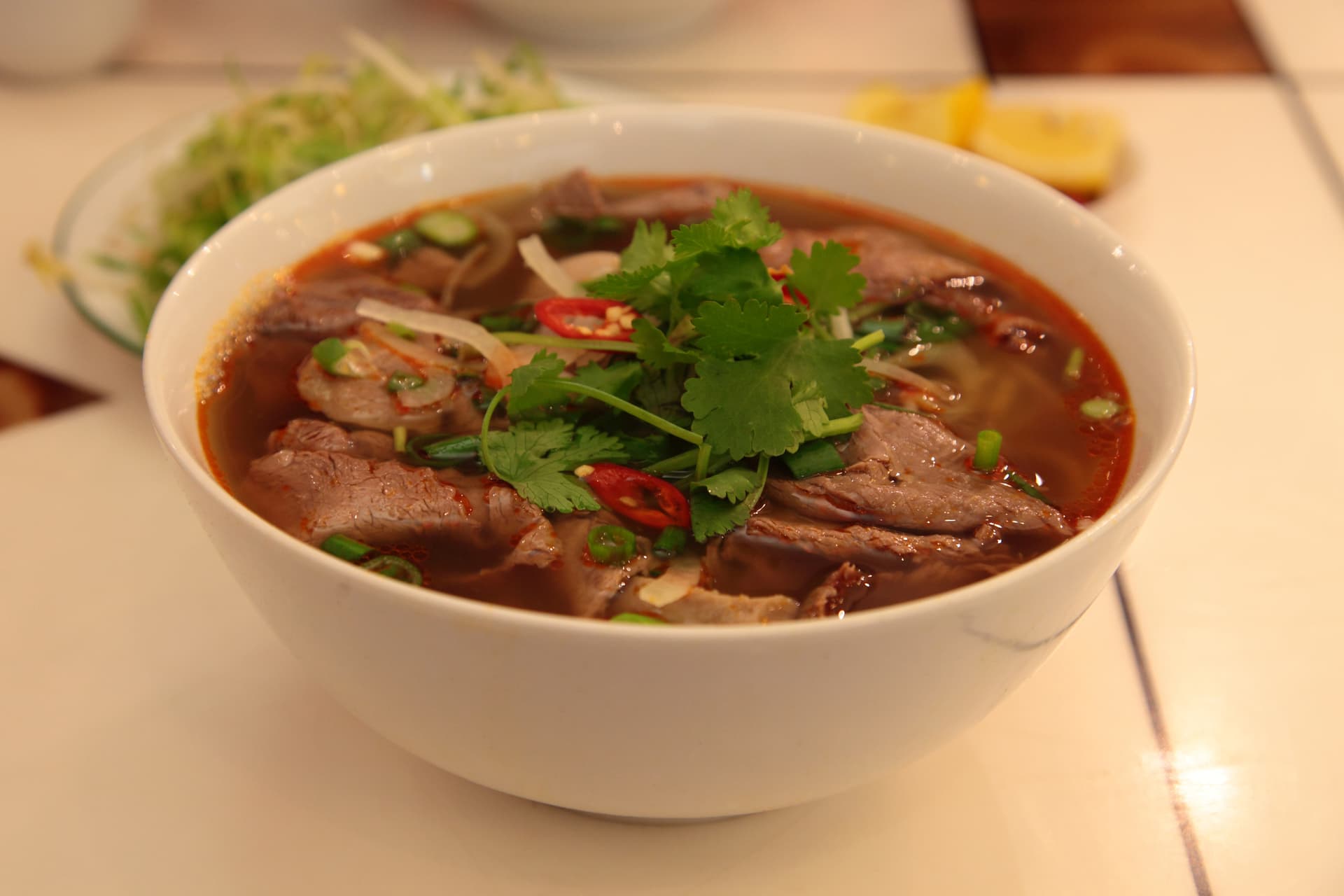
Bún bò HuếHuế (Hue)hwayFormer imperial capital of Vietnam under the Nguyễn dynasty, known for its citadel, royal tombs, and refined cuisine. is the most famous dish to come out of the old imperial capital. It is a beef-and-pork noodle soup, but the broth is built on lemongrass, fermented shrimp paste and a slick of chilli-annatto oil that turns the surface a deep brick red.
What it is
Round rice vermicelli (bún) thicker than the strands used in bún chả, served in a broth simmered for hours from beef shank and pork bones. The aromatics are crushed lemongrass and shallot. The seasoning is mắm ruốc, a pungent fermented shrimp paste, which gives the soup its salty depth. On top: a piece of beef shank, a wedge of cured pork sausage (chả Huế), often a hock of pork knuckle, sometimes a cube of congealed pig blood. The garnish plate is shredded banana flower, bean sprouts, lime, sliced chilli, and Vietnamese mint.
Origin and history
The dish belongs to Huế, capital of the Nguyễn dynasty from 1802 to 1945. Huế cuisine in general is showier and more highly seasoned than the food of Hanoi or Saigon, a legacy of having to feed and impress an imperial court. Bún bò Huế is the working-class cousin of that tradition: the same insistence on lemongrass and chilli, but in a bowl any market stall can serve.
Where to try it
In Huế, the canonical addresses are Bún Bò Bà Tuyết Tốn Thất Thiệp at 47 Tôn Thất Thiệp, and Bún Bò Mệ Kéo on Bạch Đằng. A bowl runs 40,000 to 60,000 VND. Both open early and close when the pot is empty, usually by mid-morning.
In Hanoi, look for Quán Bún Bò Huế Lý Quốc Sư or any stall on Quang Trung street. In HCMC, Bún Bò Gánh on Mạc Đĩnh Chi is a reliable air-conditioned option for around 80,000 VND.
How to eat it
Squeeze in the lime, tear the herbs by hand into the bowl, add a pinch of chilli if you can take it, and stir once. Use chopsticks for the noodles and meat, the spoon for the broth. Do not drown the bowl in sauces from the table; the broth is already finished.
Regional variations
Outside Huế the soup is often milder and sweeter, particularly in the south where a little sugar creeps into the broth. Hanoi versions sometimes drop the pork knuckle. The Huế original is the spiciest and most assertive.
Honest take
If you only ever eat phở in Vietnam you are missing the country's other great noodle soup. Bún bò Huế is louder, more perfumed and more divisive — the shrimp paste is not for everyone — but a good bowl in Huế itself is one of the great breakfasts in Southeast Asia.
Related reading: Phở, Central and southern cuisine, Huế food guide, Huế, Street food etiquette.
Pronunciation
Bún Bò Huế (pronounced boon baw way — the ư is a short 'uh', the ế is a rising tone, like asking a question).
How to order it
"Cho tôi một tô bún bò Huế" (cho toy mot taw boon baw way) — "give me one bowl of bún bò Huế". For extra chilli: "thêm ớt" (them urt). For no pork knuckle: "không chân giò" (khong chahn yaw).
Price ranges
| Tier | Indicative price (VND) | USD |
|---|---|---|
| Street stall (Huế) | 40,000–60,000 | $1.70–2.50 |
| Casual restaurant | 60,000–100,000 | $2.50–4.20 |
| Tourist-trap zone (HCMC) | 80,000–150,000 | $3.40–6.30 |
Best three neighbourhoods to try it
Huế: Tôn Thất Thiệp and Bạch Đằng wards (where the canonical stalls operate, opening before dawn). Hanoi: Quang Trung Street (Old Quarter, multiple mid-morning spots). HCMC: District 1 near Bạch Đằng and Mạc Đĩnh Chi (tourist-accessible but reliably authentic).
Common variants
- Huế original: Full pork knuckle, assertively spiced with fermented shrimp paste and chilli-annatto oil — the most aromatic version.
- Southern adaptation: Broth sweetened with a touch of sugar, milder chilli oil, omits congealed blood; eaten more for comfort than bold flavour.
- Hanoi street version: Often lighter pork presence, sometimes no knuckle, but retains strong lemongrass; faster turnover means broth simmered 3–4 hours instead of 8+.
How to order in Vietnamese
| What you want | Vietnamese | Approximate pronunciation |
|---|---|---|
| One bowl of bún bò Huế | Cho tôi một tô bún bò Huế | Cho toy mot taw boon baw way |
| Spicy | Thêm ớt | Them urt |
| Not spicy | Không ớt | Khong urt |
| No cilantro | Không rau mùi | Khong zow mooy |
| The bill | Tính tiền | Tính tee-en |
| Takeaway | Mang về | Mang way |
Price ranges
| Tier | Approximate price (VND) | Where you'll find it |
|---|---|---|
| Street stall | 40,000–60,000 | Early-morning markets and curbside stalls in Huế |
| Local sit-down restaurant | 60,000–100,000 | Neighbourhood eateries in Huế, Hanoi, HCMC |
| Tourist-oriented restaurant | 80,000–150,000 | District 1 (HCMC), Old Quarter (Hanoi), hotel-adjacent venues |
Best neighbourhoods to find it
- Huế, Tôn Thất Thiệp Ward: Historic location of the canonical Bún Bò Bà Tuyết stall; opens before dawn and closes by mid-morning.
- Huế, Bạch Đằng Ward: Home to Bún Bò Mệ Kéo and multiple family-run variants; local clientele ensures quality.
- Hanoi, Quang Trung Street: Dedicated stretch in the Old Quarter with multiple mid-morning spots; reliable quality and competitive pricing.
- HCMC, District 1: Mạc Đĩnh Chi area offers air-conditioned options; more tourist-accessible but typically faithful to the Huế original.
- Da Nang, Hàn Market area: Growing number of quality vendors as the dish spreads northward from its Huế origins.
Regional variants
- Huế (centre): The original; broth deep red from chilli-annatto oil and assertively spiced with fermented shrimp paste (mắm ruốc); typically includes a full pork knuckle and sometimes congealed pig blood.
- Southern adaptation: Broth tends to be milder and slightly sweeter, with less fermented shrimp paste; often omits the blood cube and pork knuckle; served for comfort rather than bold flavour.
- Hanoi variation: Lighter pork presence and sometimes no knuckle; retains the lemongrass base but simmers 3–4 hours rather than 8+ hours, resulting in a less concentrated broth.
- Da Nang middle ground: Bridges Huế boldness and southern sweetness; moderate chilli and fermented paste, often with a pork knuckle but less blood content.
How to tell a good version from a bad one
- Broth clarity: Look for a clean, deep red colour; cloudiness or grey tinge suggests old broth or poor stock.
- Herb and garnish freshness: Banana flower should be pale and tender, bean sprouts crisp, mint leaves bright green — wilted or brown garnish is a red flag.
- Noodle texture: Vermicelli should yield to the tooth without mushiness; overcooked noodles suggest a stall not turning stock quickly.
- Queue length in the morning: A long queue of locals before 9 a.m. typically indicates fresh broth and good turnover (as of 2026, a useful proxy in Huế).
- Meat tenderness: The beef shank should separate easily from the bone; tough or rubbery meat suggests short cooking times or reheated broth.
Frequently asked questions
Why is bún bò Huế redder and spicier than phở?
Where is the best place to try authentic bún bò Huế?
Can I order bún bò Huế without it being too spicy?
Continue reading
Comments
No comments yet.