War Remnants Museum (HCMC)
The most-visited museum in HCMC — a sobering, well-curated account of the Vietnam War from the Vietnamese perspective, with extensive photography from both sides.
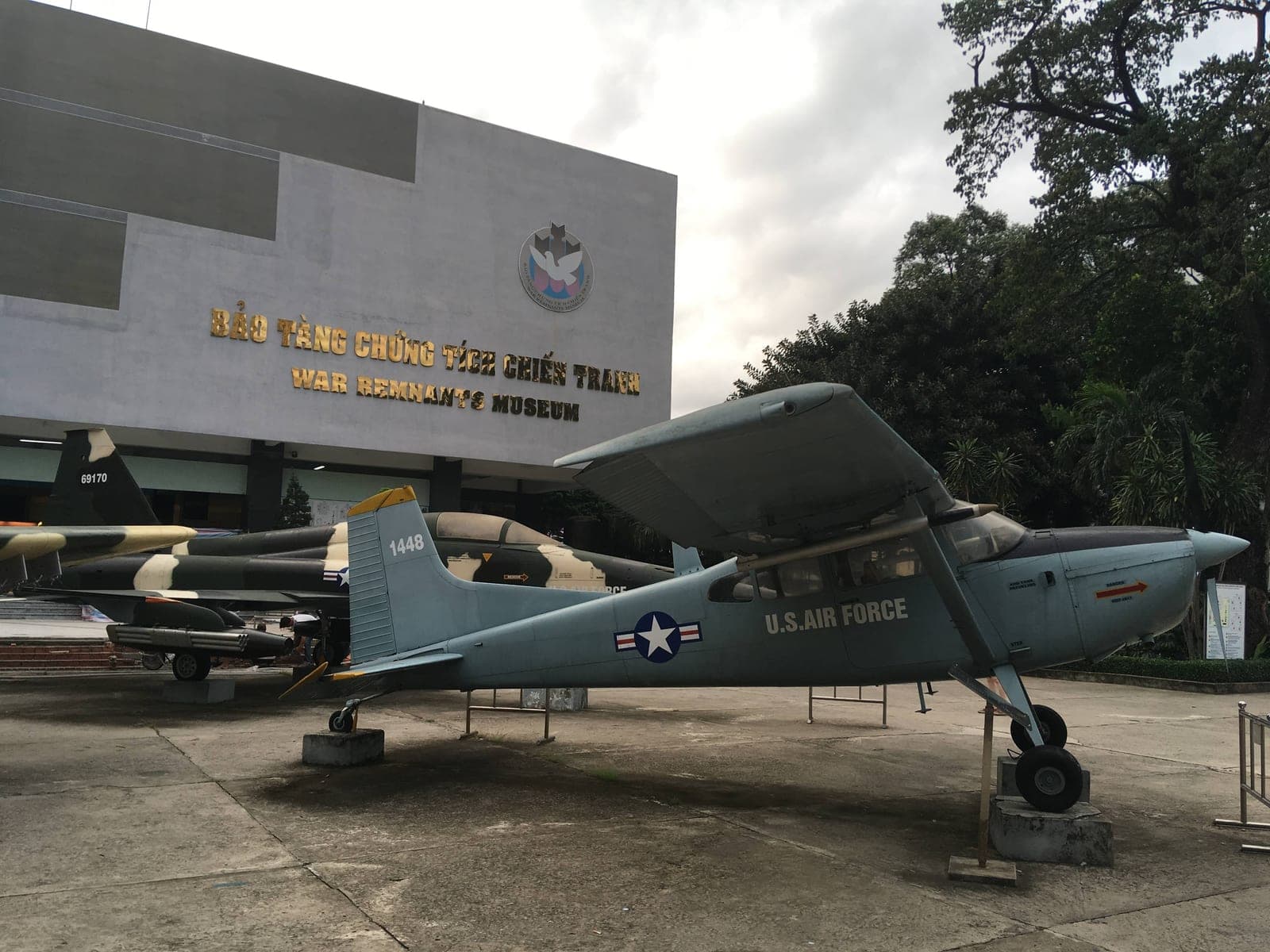
The War Remnants Museum (Bảo tàng Chứng tích Chiến tranh) is the most-visited museum in Ho Chi Minh City and one of the most important war-history museums in Asia. It occupies the former US Information Agency building at 28 Võ Văn Tần in District 3.
Originally named "Exhibition House for US and Puppet Crimes" (1975) and later "Exhibition House for Crimes of War and Aggression" (1990), it was renamed to its current title in 1995 — a softening that reflected normalisation with the United States.
It's the single most affecting museum in Vietnam and a near-essential stop for any visitor with interest in the war's history.
What's inside
The museum is spread across three floors and an outdoor area.
Outdoor area (ground level)
- Tanks, helicopters, planes, artillery: a UH-1 "Huey", F-5A fighter, M48 tank, M107 howitzer, F-5E jet. Pieces of American military hardware captured or downed.
- Replicated "Tiger Cages" — the small concrete-and-barbed-wire cells used at Côn Đảo and other prisons. Disturbing.
First floor
- Photography gallery: international war photographers — Larry Burrows, Eddie Adams, Tim Page, Don McCullin, Henri Huet, the Vietnamese photographer Võ An Khánh, and Robert Capa. Extensive and beautifully curated.
- Worldwide protest movement — photos from the global anti-war movement, 1960s–70s.
Second floor
- Agent Orange exhibition — the most affecting room in the museum. Photographs and case histories of children born with severe deformities decades after their parents' exposure to dioxin defoliants. Be warned: it is graphic and many visitors find it overwhelming.
- My Lai massacre — Ronald Haeberle's 1968 photographs.
- Children's drawings: contemporary Vietnamese students' depictions of war and reconciliation.
Third floor
- Crime of war exhibition — atrocities documented through photography and weaponry.
- Reconciliation gallery — post-1995 normalisation with the United States.
The perspective
The museum is unambiguously presented from the Vietnamese viewpoint. South Vietnamese military atrocities, the brutality of NLF reprisals against villagers, and post-1975 "re-education" camps are largely absent. Most foreign visitors find the framing understandable in context — the museum is on the site where the United States once distributed propaganda — though it's worth knowing.
The photography itself transcends framing. Eddie Adams's Saigon Execution, Nick Út's Napalm Girl, Larry Burrows's Reaching Out are here. Standing in front of them on the soil where they were taken is markedly different from seeing them in a Western textbook.
Practicalities
- Location: 28 Võ Văn Tần, District 3, HCMC. 10-minute walk from Reunification Palace.
- Hours: 07:30–17:30, daily.
- Entry fee: 40,000 VND.
- Audio guide: rentable, English available; the photo captions in English are extensive enough without it.
- Time needed: 2–3 hours to do justice; rushed visitors do it in 1.
- Photography inside: allowed, no flash.
- Children: many of the exhibits — particularly Agent Orange and the My Lai photos — are not suitable for younger children. Consider whether to bring under-12s.
Combining with other HCMC sites
The museum sits near several other tourist-essential sites:
- Reunification Palace — 10-min walk south.
- Notre-Dame Cathedral — 15-min walk southeast.
- Sài GònSài Gòn (Sai Gon)sigh gonThe historic and colloquial name for Ho Chi Minh City, still widely used by locals and expats alike. Central Post Office — beside the cathedral.
A standard half-day: Reunification Palace + War Remnants Museum + lunch + Cathedral and Post Office.
Pairing with Củ Chi
Many visitors combine War Remnants Museum + Củ Chi tunnels as separate days during their HCMC stay. The museum provides the macro context; Củ Chi provides the geographical reality. Both rather than either is the recommended pattern.
For the most thorough war-history Vietnamese itinerary, combine HCMC's museum + Củ Chi with the DMZ tour from Huế further north.
Honest take
The War Remnants Museum is heavy. Many visitors leave needing a coffee and a quiet hour. That's appropriate.
It's also fairly the most important single museum visit in Vietnam. Not visiting because the perspective is one-sided is the wrong answer — the perspective is part of the lesson. Visit, read carefully, and come away with a more textured understanding than you arrived with.
For visitors uncomfortable with graphic content, the Agent Orange room can be skipped — the rest of the museum still rewards.
Continue reading
Comments
No comments yet.