The Vietnamese Dong: Currency, History and Daily Use
The dong was introduced in 1978 to unify the post-war currency. Today it trades around 25,000 to the US dollar, with polymer notes from 10,000 to 500,000.
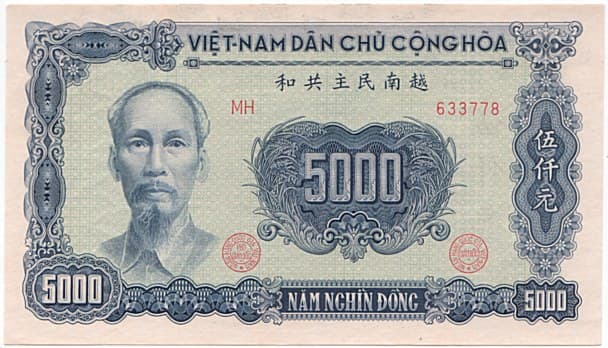
The Vietnamese dong (VND) is one of the world's lower-denominated currencies by face value, with the largest banknote in circulation worth roughly 20 US dollars. Despite that, the currency has been remarkably stable since the mid-2010s under managed-float supervision by the State Bank of Vietnam.
What it is / Background
The modern dong was introduced on 3 May 1978, replacing the two parallel post-war currencies, the North Vietnamese dong and the South Vietnamese liberation dong, after reunification. A second redenomination followed in 1985, knocking ten old dong off to one new dong, but the resulting hyperinflation of the late 1980s wiped out savings and forced the Doi Moi reforms in 1986.
From 1990 through the early 2000s the dong slid steadily against the US dollar, from around 4,000 VND per dollar to over 15,000. After WTO accession in 2007 the rate stabilised in a narrow corridor, and since 2016 the State Bank has used a daily reference rate against a basket of currencies rather than a hard peg.
Current state
In May 2026 the dong trades around 25,400 to the US dollar and roughly 27,500 to the euro. Inflation runs in the 3 to 4 per cent range, helped by stable rice and pork prices. The State Bank holds reserves of approximately 100 billion US dollars, enough to defend the band against typical capital-flow shocks.
Banknotes in circulation are 500, 1,000, 2,000 and 5,000 dong (older cotton notes, increasingly rare), and 10,000, 20,000, 50,000, 100,000, 200,000 and 500,000 dong (polymer, since 2003). Coins minted in 2003 were withdrawn from active use within a few years and are now numismatic curiosities. There is no widely-used sub-unit; the dong has no working "cents".
Key players / Major firms
The State Bank of Vietnam (SBV) sets monetary policy and intervenes in the FX market. Commercial banks Vietcombank, BIDV, Agribank and VietinBank dominate retail FX, and licensed gold shops along Ha Trung street in Hanoi and around Ben Thanh in HCMC have historically offered competitive cash rates, though the gap with bank rates has narrowed.
What's coming / Outlook
The SBV continues to manage the dong inside a narrow trading band and is unlikely to allow sharp appreciation while exports drive growth. A gradual depreciation of 2 to 3 per cent per year against the dollar is the consensus baseline. Talks about removing zeros (a redenomination of 10,000 to 1) surface periodically but face strong public resistance because of the 1985 memory.
What this means for visitors / expats
Carry mid-denomination notes for daily use: 50,000 and 100,000 are the workhorses. The 500,000 note (deep blue-green, featuring Ho Chi Minh's birthplace) is awkward at street stalls. ATMs dispense up to 3 million VND per withdrawal at most banks, with Vietcombank and BIDV ATMs typically charging 22,000 to 55,000 VND per foreign-card transaction.
Prices in tourist areas are sometimes quoted in US dollars but payment in dong is almost always cheaper. Mental conversion: drop three zeros and divide by 25 to get a rough USD figure (a 250,000 VND meal is about 10 dollars).
Sector at a glance
The Vietnamese dong underpins the broader financial services and central banking ecosystem, which handles approximately 2 to 3 per cent of regional liquidity flows and sustains daily commerce across a population of roughly 98 million. The State Bank of Vietnam manages the currency alongside four main state-owned commercial banks and dozens of licensed private and foreign institutions, employing an estimated 250,000 to 300,000 personnel across the banking and financial sector as of 2026. The sector has grown at a compound annual rate of 8 to 12 per cent over the past five years, driven by retail banking expansion, rising deposit bases and FX trading volumes tied to manufacturing exports.
| Metric | Value |
|---|---|
| Share of GDP (approx.) | 3–5% (banking & finance) |
| Workforce (approx.) | 250,000–300,000 across banking & financial services |
| Annual growth (2021–2026) | 8–12% |
| Key region(s) | Ho Chi Minh City, Hanoi, Danang (regional hubs) |
| Main export markets | Regional trade settlement (ASEAN, China, Japan, Korea) |
Key companies and operators
| Name | Role | Notable details |
|---|---|---|
| State Bank of Vietnam (SBV) | Central bank | Monetary policy, FX intervention, reserve management (~100 billion USD as of 2026) |
| Vietcombank (VCB) | Commercial bank | Largest by assets, dominant FX retail network, ~1,000+ branches nationwide |
| BIDV (Bank for Investment & Development) | Commercial bank | Second-largest state bank, major corporate lending, ~700 branches |
| Agribank | Commercial bank | Rural focus, agricultural lending, ~2,300 branches in provincial areas |
| VietinBank (Vietnam Technological & Commercial Bank) | Commercial bank | State-owned, growing e-banking services, ~1,200 branches |
| Licensed gold traders (Ha Trung, Ben Thanh) | Cash FX & bullion | Historically competitive cash rates, though gap with banks narrowing |
| Techcombank | Private commercial bank | Fintech-forward, retail deposits, ~300 branches |
| TPBank (Tien Phong Bank) | Private commercial bank | E-wallet integration, SME lending focus |
Workforce and wages
The Vietnamese banking sector employs tellers, foreign exchange officers, loan officers, credit analysts and IT specialists in a career ladder that typically runs from entry-level (16–25 million VND annually, roughly 630–990 USD per month as of 2026 in rural areas, 750–1,200 USD in Hanoi and HCMC) through mid-career (30–60 million VND annually, approximately 1,200–2,400 USD) to senior management and specialist roles (80–150 million VND annually or 3,150–5,900 USD, varies by bank seniority and branch location).
Entry-level tellers in provincial branches typically earn on the lower end; metropolitan branches and competitive private banks (Techcombank, TPBank) offer mid-range salaries. Mid-career officers with FX trading or credit expertise command 40–80 million VND annually in metro areas, equivalent to 1,600–3,150 USD. Senior roles, such as branch heads, fund managers and risk officers at major banks, often exceed 100 million VND (3,940 USD) monthly in Hanoi and Ho Chi Minh City.
Wages vary considerably by city—Ho Chi Minh City and Hanoi pay 15 to 25 per cent above provincial norms for equivalent roles. Benefits typically include health insurance, annual bonuses (one to three months' salary, depending on bank performance and role), and pension contributions. Foreign bank branches and international financial centres offer 30 to 50 per cent premiums over domestic banks for comparable roles.
Trends and outlook
- Digital transformation: Retail and corporate banking are shifting toward e-wallet, mobile-first and biometric authentication platforms, reducing dependence on physical cash and encouraging broader FX hedging among SMEs.
- Regional settlement corridors: The dong is becoming a preferred settlement currency for ASEAN trade and regional supply chains, especially in textiles, electronics and agricultural exports, driving modest appreciation pressure.
- Reserve accumulation: The SBV continues building USD reserves (currently around 100 billion) to support the currency band and weather external shocks, a multi-year commitment likely to persist through 2030.
- Remittance growth: Overseas Vietnamese transfers remain a major source of FX inflow, supporting both consumer purchasing power and official reserves; blockchain-based remittance platforms are beginning to compete with traditional banks.
- Inflation target stabilisation: The SBV targets 3 to 4 per cent inflation as a medium-term anchor, making gradual 2 to 3 per cent annual depreciation against the dollar the baseline for long-term trade competitiveness.
Risks and caveats
- Geopolitical volatility: US–China trade tensions and regional supply-chain relocations could trigger sudden capital outflows or pressure the SBV's managed-float band; defence of the band depends on reserve adequacy.
- Commodity and commodity-proxy shocks: Oil and food-price spikes (especially rice, pork and energy costs) can spike headline inflation and force SBV tightening, which in turn affects bank profitability and deposit growth; this is a recurring risk in emerging-market currency management.
- Informal economy opacity: An estimated 40–50 per cent of Vietnamese economic activity remains informal or cash-based, limiting central-bank visibility into true money-supply dynamics and making inflation targeting less precise than official statistics suggest.
- Redenomination resistance: Periodic talk of removing zeros (10,000 to 1 redenomination) encounters public distrust rooted in the 1985 hyperinflation; a forced redenomination could trigger panic dollarization or capital flight if mishandled.
Data sources: consult State Bank of Vietnam monetary-policy statements, IMF Article IV reviews for Vietnam, and official-sources.json entries for banking and currency references.
Related
Continue reading
Comments
No comments yet.