Cơm Tấm: The Broken-Rice Plate of Saigon
Grilled pork chop, a fried egg, pickles and a mound of broken jasmine rice — the classic Saigon working lunch.
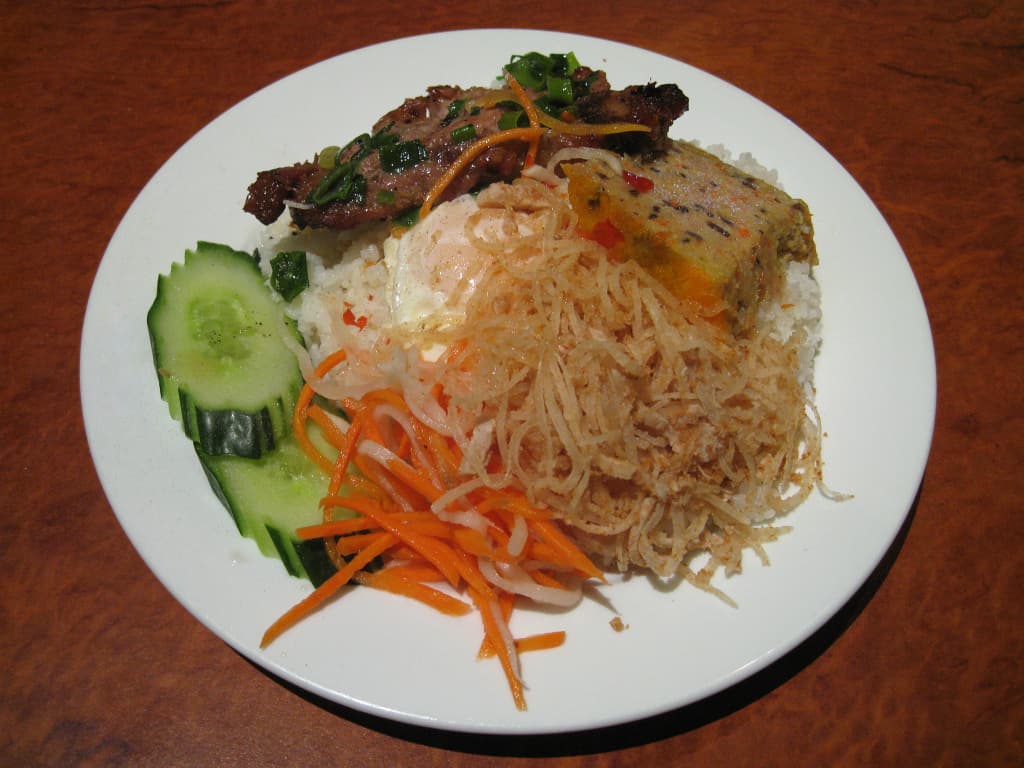
Cơm tấm — literally "broken rice" — is the most representative dish of Ho Chi Minh City. Where Hanoi runs on phởPhở (Pho)fuhVietnam's national noodle soup: a clear beef or chicken broth served with flat rice noodles, fresh herbs, and lime. and bún chả, Saigon runs on cơm tấm: a hot plate of rice with a grilled pork chop, eaten at any hour of the day.
What it is
The rice itself is fractured grains of jasmine, originally a cheap by-product of milling that the poor would buy because it cost less. Cooked, it has a slightly grainier texture than whole-grain rice. On top of it, classically: a grilled pork chop (sườn nướng) marinated in fish sauce, garlic, sugar and lemongrass; a square of steamed pork-and-egg meatloaf (chả trứng); a piece of skin-and-rind sausage (bì); a fried egg with a runny yolk; pickled carrot and daikon; a small bowl of nước chấm to pour over.
Origin and history
Cơm tấm became a city dish in the early 20th century as Saigon industrialised and rice mills threw off enough broken grains to feed workers cheaply. By the 1970s the cheap-lunch origins were forgotten and broken rice was being sold for the same price as whole rice — not because it was scarce, but because the dish had become loved on its own terms.
Where to try it
Cơm Tấm Ba Ghiền at 84 Đặng Văn Ngữ in Phú Nhuận district is the most famous, with a pork chop the size of a side plate; expect 90,000 to 130,000 VND. Cơm Tấm Nguyễn Văn Cừ in District 1 is the late-night standard. Any pavement stall with a charcoal grill and queues at lunchtime will do; a basic plate is around 40,000 to 60,000 VND.
How to eat it
Pour the small jug of nước chấm over the entire plate — it is the seasoning, not a dip. Break the egg yolk and let it run into the rice. Use a spoon and fork; chopsticks are not standard for cơm tấm.
Regional variations
Cơm tấm is southern. Hanoi versions exist but are tepid imitations. Within HCMC, the variation is in the toppings — some stalls add grilled prawn, others a skewer of fish cake — but the pork chop is non-negotiable.
Honest take
If phở is the dish foreigners learn first, cơm tấm is the one they end up eating most often if they live in HCMC. It is cheap, fast, filling, and the smell of the charcoal grills firing up at lunchtime is one of the defining sensory experiences of the city.
Related reading: HCMC food guide, Bánh mì, Central and southern cuisine, Ho Chi Minh City, Street food etiquette.
Pronunciation
Cơm Tấm (pronounced cohm tuhm — the ơ is a short, tight vowel; the ấ is higher-pitched).
How to order it
Một cơm tấm sườn (mot cohm tuhm suon) — "one cơm tấm with pork chop". At most stalls, say this and point to the charcoal grill where the chops are cooking. For extra egg, add: "Thêm trứng" (them chrung).
Price ranges
| Tier | Indicative price (VND) | USD |
|---|---|---|
| Street stall | 40,000–60,000 | $1.60–2.40 |
| Local restaurant | 70,000–90,000 | $2.80–3.60 |
| Famous shop | 100,000–130,000 | $4–5.20 |
Best three neighbourhoods to try it
Phú Nhuận District — home to Cơm Tấm Ba Ghiền, the most celebrated stall; expect queues and premium pork chops. District 1 (Quận 1) — Nguyễn Văn Cừ street is the late-night hub for cơm tấm crawlers; lighter wallet, authentic crowds. District 3 (Quận 3) — quieter locals-only stalls along Đinh Tiên Hoàng; best value and least tourist markup.
Common variants
Northern imitations — Hanoi has versions, but they're underseasoned and the rice often lacks the graininess. Protein swaps — some stalls offer grilled prawn, fish cake skewers, or shredded chicken instead of the pork chop; purists avoid these. With intestine (sách) — street vendors sometimes add grilled pig intestine; textural; acquire taste.
How to order in Vietnamese
| What you want | Vietnamese | Approximate pronunciation |
|---|---|---|
| One plate of cơm tấm | Một cơm tấm sườn | Mot cohm tuhm suon |
| Extra egg | Thêm trứng | Them chrung |
| Not spicy, please | Không cay | Khong cai |
| No cilantro/coriander | Không rau mùi | Khong rau moo-ee |
| The bill | Cái hóa đơn (or just "Bao nhiêu?" — How much?) | Cai hwa don / Bao nyoo-uh? |
| Takeaway | Mang về | Mang vay |
Price ranges
| Tier | Approximate price (VND) | Where you'll find it |
|---|---|---|
| Street stall | 40,000–60,000 | Pavement grills, markets, working-class neighbourhoods |
| Local sit-down restaurant | 70,000–90,000 | Small family-run shops in residential areas |
| Tourist-oriented restaurant | 100,000–130,000 | Famous spots (Cơm Tấm Ba Ghiền), central districts |
Best neighbourhoods to find it
- Phú Nhuận District — home to Cơm Tấm Ba Ghiền, the most celebrated stall; expect queues and premium pork chops.
- District 1 (Quận 1) — Nguyễn Văn Cừ street is the late-night hub; lighter wallet, authentic crowds.
- District 3 (Quận 3) — quieter locals-only stalls along Đinh Tiên Hoàng; best value and least tourist markup.
- Bình Thạnh District — residential area with affordable morning-shift stalls; genuine neighbourhood traffic.
Regional variants
- Northern imitations — Hanoi versions exist but tend to be underseasoned and lack the characteristic graininess of broken rice.
- Central Vietnam — cơm tấm is typically not a signature dish; the central coast favours bánh mì and bún chả.
- Southern (HCMC & Mekong Delta) — the heart of cơm tấm culture; within HCMC, variation comes from toppings (grilled prawn, fish cake, shredded chicken) rather than the core pork chop.
- Saigon-specific refinements — famous shops tend to use larger pork chops and higher-quality marination; street stalls achieve the same quality with simpler preparation.
How to tell a good version from a bad one
- Broth clarity — the nước chấm should be clear and amber, not murky; cloudiness suggests it's been sitting too long.
- Rice texture — good cơm tấm rice should be slightly grainier than whole-grain rice; if it's mushy or gluey, it's been overcooked or made from regular rice.
- Herb freshness — pickled carrot and daikon should be crisp and vibrant; dull or slimy vegetables indicate staleness.
- Queue at lunchtime — Vietnamese working-class crowds are a reliable proxy; if locals queue at 11:30am, the stall is doing something right.
- Pork chop char and tenderness — the exterior should have even charring from the grill; meat should be tender enough to cut cleanly with a spoon, not rubbery.
Frequently asked questions
What comes on a classic plate of cơm tấm?
How much does cơm tấm typically cost in Ho Chi Minh City?
Do you eat cơm tấm with chopsticks?
Continue reading
Comments
No comments yet.