Mì Quảng: The Turmeric Noodle of Quảng Nam
Broad yellow rice noodles in a small, intense broth, topped with pork, shrimp, peanuts and a shard of crisp rice cracker.
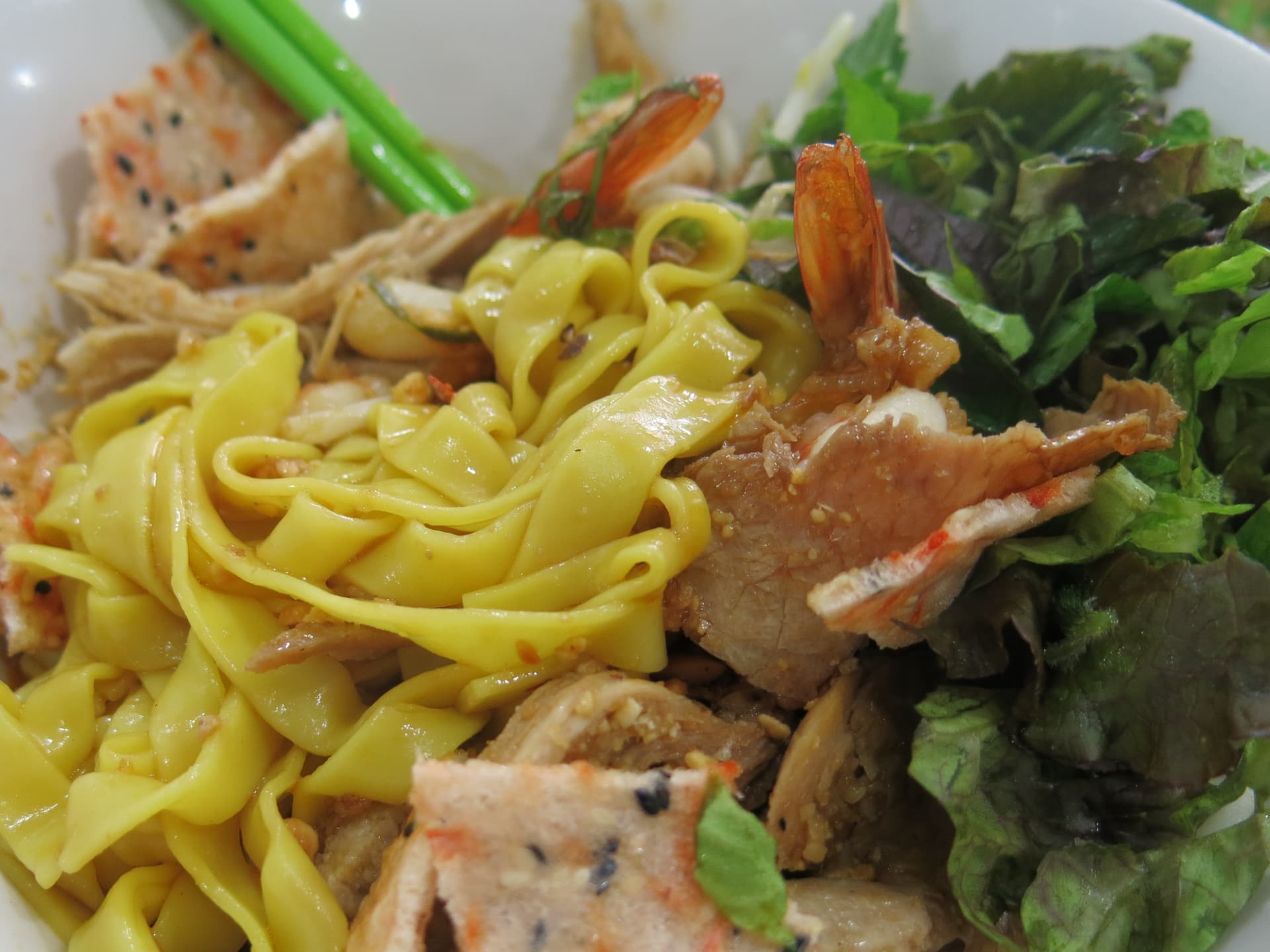
Mì Quảng is the everyday noodle of Quảng Nam province, the stretch of central Vietnam that includes Đà NẵngĐà Nẵng (Da Nang)dah nangMajor coastal city in central Vietnam, known for its beaches, the Marble Mountains, and modern infrastructure., Hội An and Tam Kỳ. It is not a soup in the phở sense — the broth barely covers the noodles — but it is one of the most distinctive dishes in the country.
What it is
Flat rice noodles dyed yellow with turmeric, served in a shallow bowl with just enough rich broth to coat them. The toppings vary: pork belly and shrimp is classic; chicken (mì Quảng gà) and freshwater fish (mì Quảng cá lóc) are common. The bowl is finished with crushed peanuts, fresh herbs, a quartered hard-boiled quail egg, and a piece of bánh tráng nướng — sesame-studded grilled rice cracker — broken into the bowl by the diner.
Origin and history
Mì Quảng dates to at least the 16th century, when Hội An was a major trading port and noodle-making techniques arrived from China. The dish became the regional staple because it travels well: the broth-to-noodle ratio means it can be carried by farmers to the fields without sloshing.
Where to try it
In Đà Nẵng: Mì Quảng Bà Mua at multiple branches, including 19 Trần Bình Trọng, is the reliable everyday version at around 35,000 to 50,000 VND. Mì Quảng 1A on Hải Phòng street is the older institution. In Hội An: Mì Quảng on Thái Phiên or any stall in the central market. In Tam Kỳ, the dish's heartland, almost any roadside spot will do.
How to eat it
Crumble the rice cracker into the bowl. Squeeze in lime, add herbs, stir from the bottom so the broth coats every noodle. Eat with chopsticks; the spoon is mostly to chase peanuts. Do not expect to drink the broth at the end — there isn't enough to drink.
Regional variations
Within Quảng Nam every town claims its own version. Đà Nẵng tends to use more broth and richer toppings; Tam Kỳ keeps it austere. Outside the central region the dish loses its character: a Hanoi-made mì Quảng is rarely worth ordering.
Honest take
Mì Quảng is the dish that tells you you are no longer in the north or south. It is rustic, peanutty, faintly bitter from turmeric, and absolutely worth seeking out the first morning you wake up in Đà Nẵng or Hội An.
Related reading: Cao lầu, Central and southern cuisine, Đà Nẵng food guide, Hội An food guide, Đà Nẵng.
Pronunciation
Mì Quảng (pronounced mee-kwang — the ì is a rising tone, a is short as in "mat", ng guttural from the throat, not nasal).
How to order it
"Cho tôi một bát mì Quảng" (cho toy mot bat mee kwang) — "give me one bowl of mì Quảng". For pork and shrimp (the standard): "Mì Quảng thường" (thuh-uhng) means "regular mì Quảng".
Price ranges
| Tier | Indicative price (VND) | USD |
|---|---|---|
| Street stall | 30,000–50,000 | 1.20–2.00 |
| Casual restaurant | 50,000–80,000 | 2.00–3.20 |
| Tourist-trap zone | 80,000–120,000 | 3.20–4.80 |
Best three neighbourhoods to try it
Đà Nẵng — Hàng Bạc market area and side streets around Trần Bình Trọng, where Mì Quảng Bà Mua operates. Hội An — Thái Phiên Street and the Central Market, where family vendors have made it since dawn. Tam Kỳ — Any roadside point south of Highway 1A; the town's obsession with mì Quảng means even casual stalls execute it perfectly.
Common variants
Northern shops add more broth and greens; the southern version (Hội An style) keeps the bowl drier and emphasises the rice cracker's texture. Seafood variants use crab, white fish (cá lóc), or squid instead of pork and shrimp. Some vendors offer mì Quảng khô (dried, without broth) — a rarity but worth requesting if you want the toasted turmeric noodle at full intensity.
How to order in Vietnamese
| What you want | Vietnamese | Approximate pronunciation |
|---|---|---|
| One bowl of mì Quảng | Một bát mì QuảngMì Quảng (Mi Quang)mee kwangCentral Vietnamese noodle dish from Quảng Nam featuring wide turmeric-yellow noodles, pork or shrimp, peanuts, and a small amount of rich broth. | Moht baht mee kwang |
| Make it spicy | Cho thêm ớt | Cho them uht |
| Not spicy at all | Không cay | Khohng kay |
| No cilantro / fresh herbs | Không cần rau | Khohng cun yow |
| The bill, please | Tính tiền | Tính tiền |
| To take away | Mang về | Mang veh |
Price ranges
| Tier | Approximate price (VND) | Where you'll find it |
|---|---|---|
| Street stall | 30,000–50,000 | Market areas, roadside pushcarts, early-morning vendors |
| Local sit-down restaurant | 50,000–80,000 | Family-run shops, casual eateries in town centres |
| Tourist-oriented restaurant | 80,000–120,000 | Downtown Hội An, tourist zones in Đà Nẵng |
Best neighbourhoods to find it
- Hanoi Old Quarter — older stalls serving the Hanoi version (more broth, less turmeric intensity)
- Hội An — Thái Phiên Street and the Central Market, where the dish originated in its modern form
- Đà Nẵng — Hàng Bạc market area and side streets around Trần Bình Trọng
- Tam Kỳ — the heartland; any roadside stall south of Highway 1A executes it authentically
Regional variants
- North (Hanoi, Hải Phòng): More broth, lighter turmeric tint, fewer toppings; often served as a late-night or early-morning dish.
- Central (Đà Nẵng, Hội An): The canonical version — shallow broth, rich yellow from turmeric, pronounced peanut crunch, crisp rice cracker essential.
- South (Hồ Chí Minh City onwards): Tends to add extra greens and softer broths; loses the characteristic dryness and intensity unless made by a central Vietnamese vendor.
- Seafood variants: Crab (cua), white fish, or squid substitute for pork; broth may be lighter and more delicate.
How to tell a good version from a bad one
- Broth clarity: Should be visibly golden from turmeric, not murky or overly oily; the bottom of the bowl should show noodles, not sludge.
- Rice cracker texture: Must be crisp and audibly snappable when broken; soggy crackers signal it was not grilled fresh that morning.
- Noodle chew: Should hold their shape and resist the spoon, not dissolve or turn mushy after a minute in the broth.
- Herb quality: Basil, mint, and cilantro should smell bright and be visibly unstained; wilted or brown-edged herbs indicate the bowl sat too long.
- Queue as proxy: In Quảng Nam, long lines at opening hour (5–7 AM) typically mean the vendor is executing consistently; empty stalls by 9 AM suggest slower turnover.
Continue reading
Comments
No comments yet.