Tây Ninh: Cao Đài Holy See and Black Lady Mountain
The mother temple of the syncretic Cao Đài religion, the highest mountain in southern Vietnam, and the Cambodian border — all 90 minutes from HCMC.
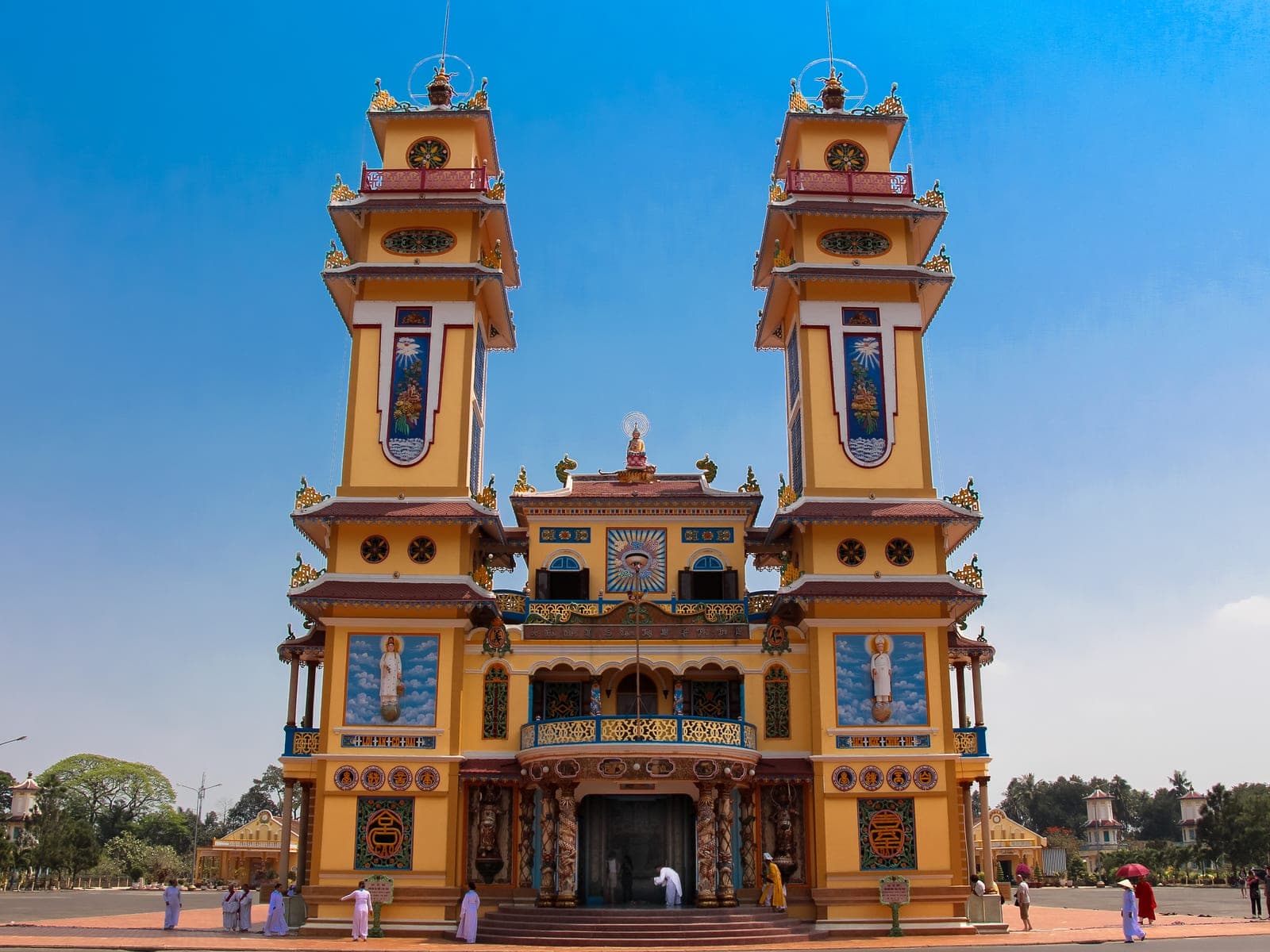
Tây Ninh province sits 90 minutes northwest of HCMC against the Cambodian border. Two attractions draw visitors: the Cao Đài Holy See in Tây Ninh city, and Núi Bà Đen (Black Lady Mountain), the highest peak in southern Vietnam. Most visitors do both as a single day trip from HCMC, often combined with the Củ Chi tunnels.
The Cao Đài Holy See
Cao Đài is a syncretic Vietnamese religion founded in Tây Ninh in 1926. It draws on Buddhism, Catholicism, Taoism, Confucianism and folk traditions, and its pantheon of saints includes Victor Hugo, Sun Yat-sen, and the Vietnamese poet Nguyễn Bỉnh Khiêm.
The Holy See itself is a vast multi-coloured cathedral, finished in the 1950s. The interior is striped pink, blue and yellow with dragon-wrapped columns, an all-seeing eye on every wall, and a domed ceiling painted with stars and clouds. There are four daily prayer ceremonies (6 am, 12 noon, 6 pm, midnight). The noon ceremony is the one tour buses time their visit to. Spectators watch from a balcony.
Dress modestly (shoulders and knees covered). Shoes off at the entrance to the main hall. Photography is allowed from the balcony but not on the prayer floor.
Núi Bà Đen (Black Lady Mountain)
A 996 m volcanic plug rising from the flat plain — visible for 30 km on a clear day. The mountain is sacred in local folklore (the "Black Lady" is a legendary virgin who died on the mountain) and is topped with several pagodas.
Three ways up:
| Route | Time | Notes |
|---|---|---|
| Cable car | 8 min | The fast option; runs to multiple stations including the summit |
| Stone steps | 1.5 hr | Goes via the lower pagodas; popular pilgrimage |
| Hiking trail | 3 hr each way | Steep and hot; bring water |
The summit cable car has been operating since 2020 and made the mountain a year-round destination for domestic tourists. The view from the top — out over the Mekong plain to Cambodia — is genuinely good on a clear day.
How to combine with Củ Chi tunnels
The standard day-trip from HCMC:
- 7 am — Depart HCMC.
- 9 am — Củ Chi tunnels (2 hours).
- 11:30 am — Drive to Tây Ninh (1 hour).
- 12 noon — Cao Đài Holy See for the noon ceremony.
- 2 pm — Lunch, then Núi Bà Đen cable car.
- 5 pm — Return to HCMC.
Tour operators in HCMC sell this as a packaged day for $30–60. Doing it independently with a car and driver costs $80–120 for the day and gives you more flexibility on timing.
When to visit
Year-round but the cable car can close in heavy rain. Spring (Feb–Apr) and autumn (Oct–Nov) are the most comfortable. TếtTết (Tet)tetVietnamese Lunar New Year, the most important national holiday, typically in January or February; a time for family reunion, ancestor worship, and new-year rituals. (Vietnamese new year, late Jan / early Feb) brings huge pilgrimage crowds to the mountain.
Where to stay
Most visitors don't sleep in Tây Ninh — they come from HCMC for the day. If you want to stay overnight there are mid-range hotels in Tây Ninh town near the Holy See. For something more atmospheric, several boutique resorts have opened around Núi Bà Đen in recent years.
Practicalities
- Cao Đài entry: free.
- Núi Bà Đen cable car: 250,000–400,000 VND depending on route (cheaper without the summit station).
- Modest dress at the Holy See; comfortable shoes for the mountain.
- Hot all year — bring water, sun protection, hat.
Beyond the day trip
Tây Ninh province also borders Cambodia at Mộc Bài crossing, which is the main land route from HCMC to Phnom Penh and the popular visa run destination. Buses depart Phạm Ngũ Lão area of HCMC frequently.
Adjacent provinces worth combining: Bình Dương (industrial-park heartland) and Bình Phước (cashew country) — neither is a tourist destination but both add context if you're road-tripping the southern hinterland.
Long An
This area is now part of Tây Ninh province and is known as flat rice country at the edge of the Mekong Delta, quieter and with far less tourist infrastructure than the delta provinces further south.
The landscape is wetland: extensive rice paddies, and on the western edge, the Plain of Reeds (Đồng Tháp Mười) — the area is among the most flood-prone parts of the delta. The main visitor draw is Làng Nổi Tân Lập (Tân Lập Floating Village), a melaleuca-forest park reached by small boats through narrow canals, quiet on weekdays and busier at weekends. Boat tours are usually arranged through guesthouses or the village's own booking office, running 60,000–100,000 VND per person for 2–3 hours including paddling.
Away from the floating village, small delta towns such as Hậu Nghĩa and Cần Đước offer quiet provincial life, riverside markets and French-era bridges. For archaeology enthusiasts, Vĩnh Hưng Tower is a 9th–10th-century Cham brick ruin — the southernmost Cham monument in Vietnam — though interpretive signage there is limited.
The former provincial capital, Tân An, sits on the main HCMC–Cần Thơ highway, 1.5–2 hours from HCMC by car, bus or Grab; there is no rail or air service. A handful of business hotels operate in Tân An, but most visitors still overnight in Mỹ Tho, Bến Tre or HCMC rather than staying locally.
November–April, the dry season, gives easier road conditions. August–October is the floating-rice season — the most evocative landscapes — but practical access can be limited by flooding. Grab covers Tân An and the main roads but is less frequent in rural areas, where xe ôm (motorbike taxis) run at roughly 20,000–30,000 VND for short hops; renting a motorbike in Tân An costs about 80,000–120,000 VND per day.
For most travellers this remains a place passed through on the way to the Mekong Delta proper, rather than a destination in itself.
Quick verdict
Tây Ninh is a spiritual and scenic outpost 90 minutes from HCMC built around the Cao Đài Holy See, a wildly colorful syncretic temple drawing pilgrims daily, and Núi Bà Đen, a sacred volcanic peak offering cable-car summits and panoramas over the Mekong plain into Cambodia. Most visitors treat it as a day trip bundled with the Củ Chi tunnels, making it a gateway to understanding Vietnam's religious syncretism and southern hinterland character. It's accessible, well-touristed, and visually singular — the temple architecture alone justifies the road.
Best for / not ideal for
Best for:
- Day-trippers from HCMC seeking religious and mountain culture in one morning
- Photography enthusiasts (the temple's pink-blue-yellow interior and mountain views are Instagram staples)
- Cycle tourists or road-trip planners using Tây Ninh as a visa-run stop en route to Cambodia
Not ideal for:
- Visitors expecting a "quiet" religious experience (tour-group crowds at noon prayers, cable-car queues on weekends)
- Hikers wanting a solitary mountain walk (the cable car dominates; stone-step pilgrimage routes are crowded during festivals)
How long to stay
A full day trip from HCMC is realistic: depart 7 am, hit Củ Chi tunnels by 9, Cao Đài for the noon ceremony by 12, cable car or hike Núi Bà Đen by 2 pm, back in the city by 5 pm. If staying overnight, 1 night minimum allows a sunrise cable-car ascent and less rushed temple visit, though most visitors don't sleep in Tây Ninh itself.
Climate by month
February–April and October–November are the most comfortable, with lower humidity and occasional cloud cover on the mountain. May–September is hot, humid, and prone to afternoon rain that can close the cable car for hours. Tết (late January/early February) brings massive pilgrim crowds and can make parking and temple access chaotic.
Day trips from here
- Ho Chi Minh City (90 min south) — reversing the standard day trip, staying in Tây Ninh and day-tripping to HCMC for museums/Saigon center
- Bình Dương (60 min east) — industrial hinterland with Lai Thiêu market and rubber-plantation history
- Mộc Bài border (50 min west) — the main Cambodian crossing; buses to Phnom Penh depart nearby
- Bình Phước (90 min northeast) — cashew-farming country and Tây Ninh's quieter sibling
Local transport
Tây Ninh city and Núi Bà Đen are spread apart; independent travelers will need a taxi or Grab. Grab is reliable in Tây Ninh town (base fare ~50,000 VND) but scarce on the mountain; arrange rides in advance or book a car-with-driver for the day ($80–120 for full day including driver and fuel, 8 hours). Motorbike taxis (xe ôm) cluster near the temple entrance. Walking between attractions isn't practical; the mountain cable car is the only reasonable ascent for most visitors.
Continue reading
Comments
No comments yet.