Ninh Bình
"Hạ Long Bay on land" — limestone karsts, sampan rivers, the country's largest pagoda, and Vietnam's first imperial capital, all an easy two hours south of Hanoi.
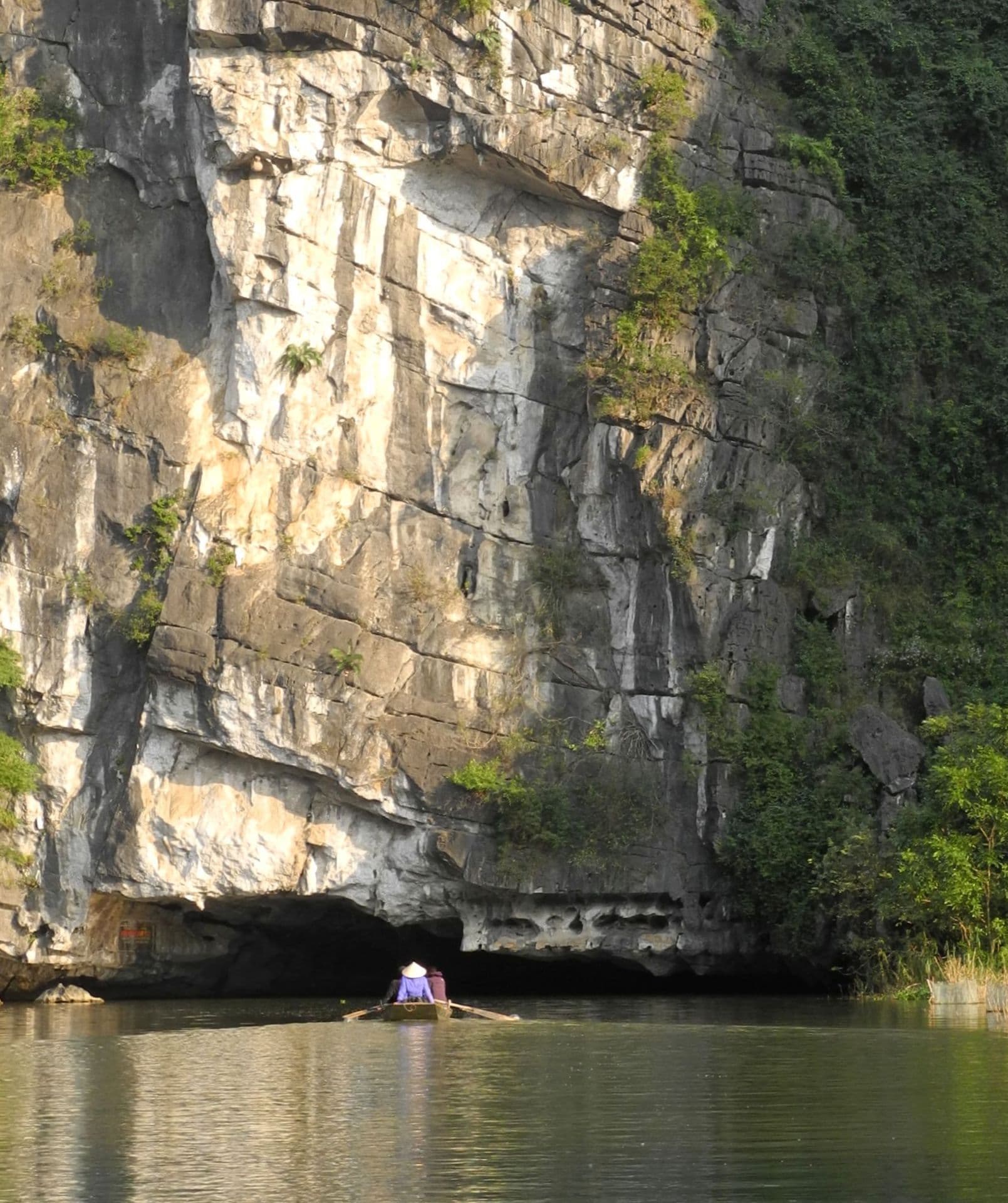
Ninh Bình is the easiest big-landscape day from Hanoi, and the most rewarding overnight in the Red River delta. The same karst geology as Hạ LongHạ Long (Ha Long)hah longBay in northeastern Vietnam featuring thousands of limestone karst islands; a UNESCO World Heritage site and top cruise destination. Bay — except here the pinnacles rise out of rice paddies and slow rivers instead of the sea, and there are no tour boats to fight for space. Most travellers come for a day; two nights is the right answer.
What to see
| Site | Why go | Ticket |
|---|---|---|
| Tràng An | Three-hour sampan loop through nine caves and three temples | 250,000 VND |
| Tam Cốc | Shorter, more famous boat ride, can be busy and pushy with photo sellers | 195,000 VND |
| Hang Múa | 500-step climb to the lion-and-dragon viewpoint over Tam Cốc | 100,000 VND |
| Bích Động Pagoda | 15th-century pagoda built into a cliff, near Tam Cốc | Free |
| Hoa Lư | The 10th-century imperial capital before Hanoi | 20,000 VND |
| Bái Đính | The largest Buddhist complex in Southeast Asia, 2003-built and grandiose | Free, electric buggies 60,000 VND |
| Phát Diệm Cathedral | A Vietnamese-Catholic cathedral in stone-and-timber Sino-Vietnamese style | Free |
| Cúc Phương National Park | Vietnam's oldest national park; primate rescue centre | 60,000 VND |
Tràng An is the better boat ride — longer, quieter, and the rowers are not allowed to ask for tips. Tam Cốc is more crowded and the touts in the boats can be aggressive about postcards and embroidery. Hang Múa is the photo people come for; arrive at 6:30 am for the haze rising off Tam Cốc, or 4:30 pm for soft light without the heat.
How to get there
Hanoi to Ninh Bình city is 95 km. Options:
- Limousine van: 200,000 VND, 2 hours door-to-door. Operators include Khanh An and 12Go agents.
- Train: Hanoi → Ninh Bình on the reunification line, SE3 or SE5, around 2 hours and 100,000 VND in soft seat. Sit on the east side for paddy views.
- Public bus: Giáp Bát station, 80,000 VND, 2.5 hours.
- Day tour from Hanoi: 700,000–1,200,000 VND including transport, Tràng An, Hoa Lư and Mua Cave. Convenient but rushed.
Once in Ninh Bình, the main sights are 5–12 km from town. Hire a scooter (150,000 VND/day) or a private car (around 800,000 VND/day).
When to visit
| Months | Notes |
|---|---|
| Late May | Rice turning gold, the postcard season — peak prices |
| Sept–Nov | Cooler, second rice harvest, fewer crowds |
| Dec–Feb | Cool (15–20°C), foggy mornings on the river, quiet |
| Jun–Aug | Hot and humid; storms can shut boat rides |
The famous yellow-rice shots in Tam Cốc are a narrow 2–3 week window in late May / very early June. See weather by month.
Where to stay
The boutique-homestay scene around Tam Cốc is one of the best in Vietnam. Recommended:
- Tam Coc Garden Resort — long-running mid-range with a pool, around US$120
- Banana Tree Homestay — well-run budget, US$25
- Tam Coc Rice Fields Resort — bungalows in the paddies, US$80
- Hidden Charm Hotel — closer to Tràng An, US$70
- Emeralda Resort Ninh Bình — the upmarket option, US$200+
Avoid staying in Ninh Bình city itself — it is a charmless transit town. The villages around Tam Cốc and Tràng An are 15 minutes away and infinitely nicer.
Food
Dê núi (mountain goat) is the local speciality — grilled, in spring rolls (gỏi dê), or in hotpot. Cơm cháy (crispy rice cracker) is the regional snack, often served with a sweet pork-and-shallot topping. Try both at Đức Dê or Thăng Long restaurants in town.
Hà Nam
Hà Nam, immediately north of Ninh Bình on the way to Hanoi, is now part of Ninh Bình province and is known above all for the Tam Chúc pagoda complex.
Tam Chúc, in the former Kim Bảng district, is typically described as the largest Buddhist pagoda complex in Vietnam by land area, spread across a site framed by limestone hills and a large lake. The complex includes halls housing large Buddha statues, an electric buggy or boat route across the lake to the inner temple area, and a hillside stupa reached by a long staircase. Construction has continued in phases, so it's worth confirming with a guide or on-site signage which sections are open on a given day. Entry to the grounds is typically low-cost or free, while the boat or buggy transfer across the lake usually carries a separate fee that has changed over time. Weekends, Tết, and lunar festival dates bring large domestic crowds, so a weekday morning visit is quieter.
Nearby, Bà Đanh pagoda offers a contrast: a modest, centuries-old pagoda beside the Đáy River, long associated with the Vietnamese idiom "vắng như chùa Bà Đanh" (as deserted as Bà Đanh pagoda), used for a quiet or empty place — though in practice it gets a steady trickle of visitors rather than none. Pairing Tam Chúc and Bà Đanh in one day is a common itinerary.
Other, less-visited sites include Đọi Sơn hill near the former provincial capital Phủ Lý, home to Long Đọi Sơn pagoda with roots reportedly reaching back to the Lý dynasty, and a historic rice-planting ceremony revived as a symbolic festival. Vũ Đại village, associated with writer Nam Cao and his story "Chí Phèo," draws a small number of literary-minded visitors. None of these need more than a couple of hours and are usually treated as add-ons around a Tam Chúc visit.
Phủ Lý is reached from Hanoi by Highway 1A or the parallel expressway, roughly an hour to ninety minutes by road; the area is also a stop on the north-south railway. Public bus connections to the pagoda area itself are limited, so a private car, organised tour, or motorbike is the practical way in.
Nam Định
Nam Định, on the southeastern side of the delta, is now part of Ninh Bình province and holds three separate claims to national significance: a rival origin story for phở, the ancestral seat of the Trần dynasty, and one of the country's highest concentrations of Catholic churches.
Locals in Vân Cù village, just outside Nam Định City, argue that itinerant noodle sellers from their village were making a proto-phở broth in the late 19th century and carried it north to Hanoi, rather than the dish emerging there first as the standard history holds. Written records from the period are thin, so food historians are split between calling it plausible or unprovable. Nam Định phở exists today as a distinct regional style — typically clearer and slightly sweeter than classic Hanoi phở, with a thinner, more translucent noodle and less star anise and cinnamon — and a museum-style eatery in Vân Cù serves the "original" broth to visitors.
Nam Định City was also the ancestral homeland of the Trần dynasty, which ruled Đại Việt from 1225 to 1400 and repelled three Mongol invasions under generals such as Trần Hưng Đạo. The Trần Temple (Đền Trần) complex there includes Thiên Trường Temple, for the Trần emperors, and Cố Trạch Temple, dedicated to Trần Hưng Đạo — busy with pilgrims year-round. Its biggest event, the Lễ Khai Ấn Đền Trần "opening of the seal" ceremony, falls in the middle of the first lunar month and draws enormous crowds for a single night; gate-crashing and paid-scalping of seal papers have drawn periodic media criticism, so current-year arrangements are worth confirming locally.
In Vụ Bản district, Phủ Dầy is a major pilgrimage centre for Đạo Mẫu, the Mother Goddess religion centred on the deified Liễu Hạnh. Its festival, in the third lunar month, draws large crowds for lên đồng spirit-possession rituals, recognised by UNESCO as intangible cultural heritage in 2016.
Bùi Chu, in the southeast, has been a Catholic diocesan centre since the 19th century, dense with churches blending French Gothic and Vietnamese decorative styles; its 1880s cathedral survived a 2019 demolition controversy through a renovation compromise instead. Nam Định City is roughly two hours from Hanoi by train, or two to two and a half hours by car along National Route 1.
Honest take
Ninh Bình punches well above its weight and is the single best out-of-Hanoi trip if you only have one to make. Skip Hạ Long Bay day cruises and do Ninh Bình instead — same karst, no diesel haze, half the price. For the bay proper, give it two nights minimum or use Cát Bà island.
Quick verdict
Ninh Bình is inland Hạ Long — limestone karsts rising out of paddies, not sea, with boat rides through caves and three centuries of royal history in one compact pocket. It's loved for the quiet Tràng An sampan loop, the golden-rice window in May, and the fact that it's genuine and unspoilt compared to its coastal cousin. It's not a beach destination, not a multi-day trekking wilderness, and not ideal if you're jet-lagged and immobile.
Best for / not ideal for
Best for:
- Day-trippers from Hanoi who want landscape drama without a 12-hour tour
- Photographers chasing the May rice-gold moment (late May to early June)
- Overnight couples or small groups wanting boutique homestays and Mekong-style river atmosphere in easy reach of the capital
Not ideal for:
- Beach holidays or island hopping
- Travellers on a tight budget (homestays are mid-range, transport by scooter adds cost)
- Peak summer visitors who can't handle heat and humidity
How long to stay
Two nights is the ideal stretch — enough for both Tràng An and Tam Cốc (one per day) plus a morning at Hang Múa or Hoa Lư. One overnight is a light squeeze; three nights lets you add Bái Đính pagoda and a quieter pace. Day-tripping from Hanoi is possible but exhausting.
Climate by month
May and October–November are best: the former gives the yellow-rice look, the latter offers cooler air (18–24°C) and clearer skies. Avoid June–August (heat, storms, boat shutdowns) and the coldest Feb mornings if you're in an unheated homestay. See weather by month for the full picture.
Day trips from here
- Hoa Lư — 10th-century imperial capital temples, 30 minutes by scooter
- Cúc Phương National Park — Vietnam's oldest park with primate rescue centre, north of Ninh Bình
- Hanoi — 95 km north via train (2 hours, scenic east-side route) or limousine van
- Hạ Long Bay — 120 km north for the sea version of karst, full-day trip
Local transport
Most visitors hire a scooter (150,000 VND/day) or split a private car. Grab operates in Ninh Bình city but is less reliable in the countryside villages; Be and Xanh SM are available. Walking is fine if your homestay is centrally placed (Tam Cốc area), but the sights are too spread out otherwise. Motorbike is the local way.
Continue reading
Comments
No comments yet.