My Son Cham ruins day trip from Hoi An or Da Nang
My Son was Vietnam\’s Angkor for the Cham kingdoms. War-damaged but evocative. The sunrise tour is the right one; here is why.
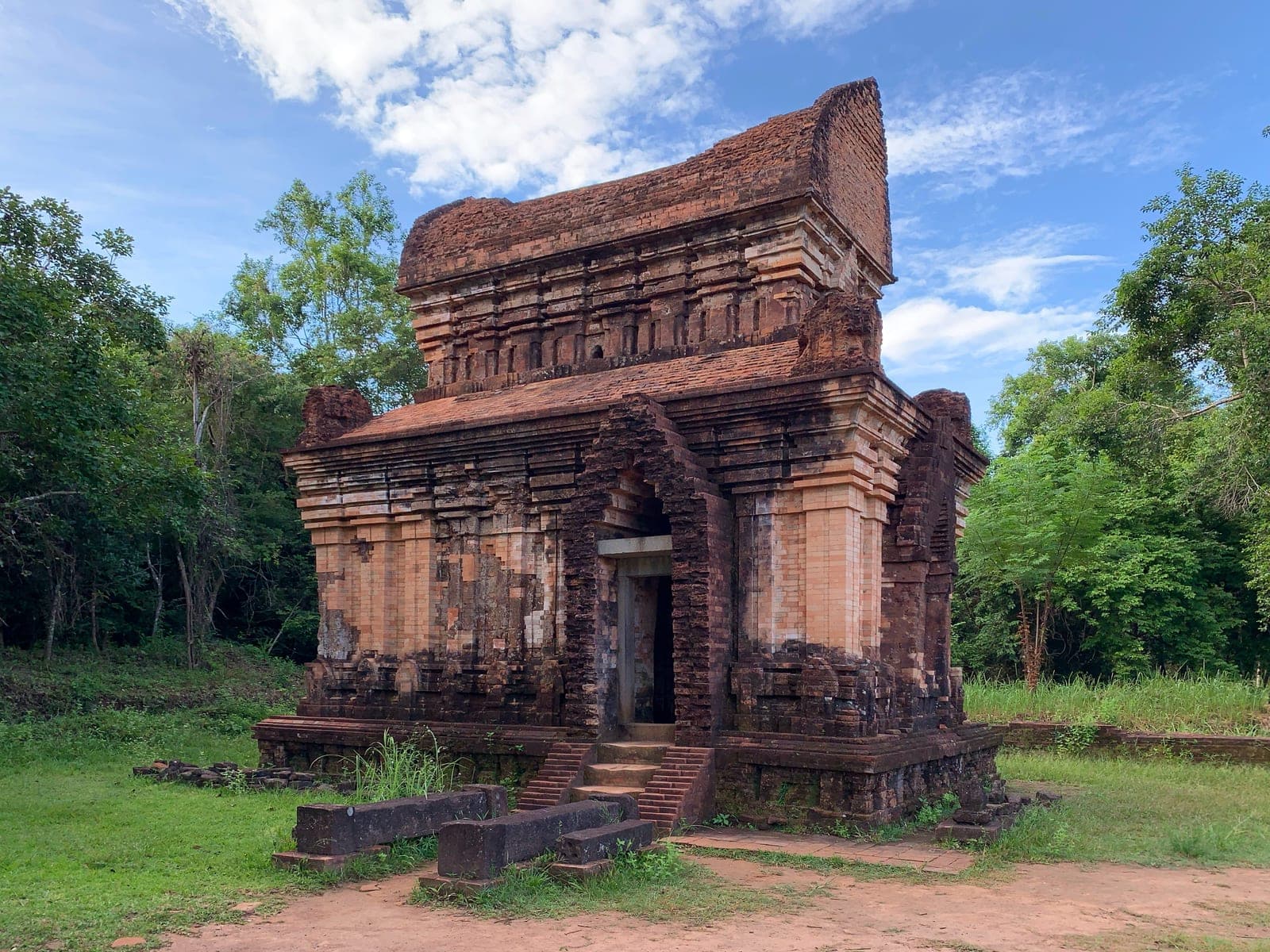
My Son sits in a narrow valley about 40 km southwest of Hoi An, surrounded by forested hills. It is a UNESCO World Heritage Site and the most significant surviving collection of Cham religious architecture in Vietnam. It is also war-damaged, partially restored, and not nearly as intact as photographs sometimes suggest. Going in with realistic expectations means you will come away satisfied.
What My Son is
My Son is a sanctuary complex — not a city. The Cham built it as a religious centre dedicated to Shiva, and construction continued across roughly ten centuries, from around the 4th century CE to the 14th. At its peak the site held around seventy brick tower structures. Today fewer than twenty remain in any meaningful form, and several of those are heavily reconstructed.
What survives is still worth the trip. The brick towers that are intact carry detailed bas-relief carvings. The valley setting is genuinely atmospheric. On a quiet morning, before the tour coaches arrive, it can feel remote and serious in the way that good historical sites do.
The Cham kingdom context
The Cham were the dominant power in central and southern Vietnam for much of the first millennium CE. Their kingdom, Champa, controlled trade routes along the central coast and had cultural ties to Hindu India that show clearly in the architecture at My Son — the tower forms, the iconography, the orientation toward the sacred mountain.
Champa gradually lost territory to the expanding Viet kingdoms from the north, and by the 15th century the kingdom had effectively collapsed. My Son was abandoned and eventually reclaimed by jungle. French archaeologists rediscovered it in the late 19th century and began documentation and partial restoration. For a broader look at how My Son fits into the country's archaeological record, see our page on archaeological sites.
War damage realities
This is the difficult part. During the American War, My Son was used as a Viet Cong base. US bombing in 1969 — including a week of B-52 strikes — destroyed a significant portion of the site, including what archaeologists considered the finest tower group. Photographs from the early 20th century show structures that no longer exist.
Polish and Vietnamese restoration teams have worked on the site since the 1980s, and UNESCO-funded work has continued since inscription in 1999. Some of the restoration has been criticised as heavy-handed, with new brick and concrete visible in places. Be aware of this before you go. The site is worth visiting, but it is not pristine.
Getting there from Hoi An
Hoi An is the standard base for My Son. The distance is roughly 40 km by road. Most visitors join a group tour that departs from Hoi An, which handles transport and the entry ticket. Independent travel is straightforward: hire a motorbike taxi, book a private car, or rent a motorbike yourself if you are comfortable with Vietnamese roads. The road is paved and not technically difficult.
Journey time is typically 50 to 70 minutes depending on traffic and route. There is no direct public bus service as of 2026.
Getting there from Da Nang
Da Nang is around 60 km from My Son. Most people visiting from Da Nang join a tour that combines My Son with Hoi An in a single day. This is a reasonable approach — you see the ruins in the morning and spend the afternoon in the old town. Private car hire from Da Nang to My Son and back, without stopping in Hoi An, costs more per person unless you are travelling as a group.
The sunrise tour case
The standard argument for the sunrise tour is sound. My Son opens early, and the group tours from Hoi An that depart around 05:00 arrive before the main wave of day-trippers. The valley light in the early morning is better for photographs. It is also meaningfully cooler, which matters between April and October when midday temperatures at the site can be uncomfortable.
The sunrise tour typically returns to Hoi An by midday, leaving the afternoon free. The main downside is the early start. Most travellers who do both the standard and sunrise tour say they prefer the sunrise version. If you have only one chance to go, the sunrise departure is the better option.
Standard tour vs private guide
Group tours from Hoi An cost roughly 200,000 to 300,000 VND per person including transport and entry, sometimes with a boat leg on the return. They work well for most visitors. The guides vary in quality; some are excellent, some cover only the basics.
A private guide adds meaningful depth, particularly on the Cham religious iconography and on the specific history of the bombing damage. Expect to pay 800,000 to 1,500,000 VND or more for a private guide on top of transport and entry. This is worth considering if you have a strong interest in history. My Son is one of the places covered in our guide to the best for history destinations in Vietnam, and visitors with that interest tend to get more from a private arrangement.
Pricing
Entry to My Son as of 2026 is 150,000 VND per adult. This is the gate price. Most group tours include this in the package price. If you arrive independently, you pay at the gate.
Parking is charged separately for motorbikes and cars. A basic group tour from Hoi An including transport and entry runs approximately 200,000 to 350,000 VND per person. Tours including a boat ride on the Thu Bon River for the return leg typically cost more. Private car hire from Hoi An for a half-day runs approximately 600,000 to 900,000 VND for the vehicle.
Combining with the Cham Sculpture Museum (Da Nang)
The Cham Sculpture Museum in Da Nang holds the largest collection of Cham artefacts in the world — statues, lintels, and decorative pieces removed from My Son and other Cham sites over the past century. Visiting the museum before or after My Son significantly improves the experience at the ruins, because you can see the quality of what was carved and understand what the standing structures originally contained.
The museum is in central Da Nang and is straightforward to visit independently. Entry is low cost. If you are travelling between Da Nang and Hoi An and want to understand the Cham period properly, the museum plus My Son combination is the most complete approach available.
Frequently asked questions
Is My Son ruins worth visiting given the war damage?
Should I take the sunrise tour to My Son?
How do I get to My Son from Hoi An or Da Nang?
Related
- Hoi An old town guide
- Best places for history in Vietnam
- Archaeological sites of Vietnam
- Da Nang city guide
- Best day trips from Hoi An
Why visit My Son ruins
My Son is Southeast Asia's most significant Hindu-Buddhist temple complex outside Cambodia and Thailand. Unlike Angkor, the Cham towers here are built from brick rather than stone, and the craftsmanship in the surviving bas-reliefs is intricate and intimate. The war-damaged sections are honest reminders of history; the restored towers stand in thick jungle that creates an atmosphere of genuine discovery. Most visitors leave impressed by both the architecture and the tangible sense of a civilization that peaked a thousand years ago.
When to go
Visit between November and April when temperatures are mild (20–28°C) and humidity drops. Avoid May through September entirely — monsoon rains hit the valley hard and muddy the pathways. The site rarely closes, but proceed carefully after heavy storms. Sunrise departures (05:00–06:00 from Hoi An) avoid the 10:00–15:00 coach crowds and give you clean light for photographs and reflection without the noise.
How to get there
My Son is 40 km southwest of Hoi An (50–70 minutes by road). Most travelers join a sunrise group tour from Hoi An (200,000–300,000 VND including entry), which is efficient and social. Private motorbike taxis cost 300,000–500,000 VND each way for 2–3 people. Self-driving requires confidence on Vietnamese country roads. From Da Nang (60 km) you can hire a private car for approximately 700,000 VND or join a combined My Son–Hoi An tour.
What to see and do
- Group A & B towers: The most intact structures, carved with Shiva imagery and architectural detail
- The war-damage realisation walk: Photograph the craters and destroyed foundations from the 1969 bombing
- Bas-relief carvings: Look closely at the remaining lintels and corner stones — the craftsmanship justifies the UNESCO status
- Museum pavilion: Small onsite exhibition with artefacts and restoration photos; helps contextualise what you're seeing
- Sunrise photo sequence: Arrive 45 minutes before sunrise and walk the main axis east to west as light breaks through the valley
Where to stay nearby
Stay in Hoi An (5 km away; rooms from 300,000 VND budget to 2,000,000 VND mid-range) and take the sunrise tour, or base yourself in Da Nang for more amenities and higher-end options (150,000–3,000,000 VND). Homestays in the small villages directly below My Son (around 500,000 VND) offer immersion but limited facilities. The Hoi An base remains the logical choice for most travelers.
Practicalities
- Entry: 150,000 VND, open 06:30–17:00 daily
- Parking: 5,000–10,000 VND for motorbikes/cars
- Fitness level: Moderate; many steps on uneven terrain and some steep climbs to Group B; wear sturdy shoes
- Heat & sun exposure: The valley offers some shade, but bring water and sunscreen; heatstroke is real in May–September
- Foreigner pitfall: Do not bargain your entry fee with unofficial guides near the gate. Purchase from the official ticket office only; counterfeit tickets lead to gated entry conflicts. Stick with established tour operators or the official ticketing desk.
Continue reading
Comments
No comments yet.